


You've booked the appointment, sat through the treatment, and maybe winced through a needle or two. Now you're staring at a printed aftercare sheet, scrolling through conflicting advice online, and wondering whether you're supposed to wash your face tonight or leave it well alone. Sound familiar?
Post-procedure skincare is where so many people lose the plot, not because the advice is complicated, but because it's inconsistent. One clinic says avoid water for six hours; another says cleanse straight away. The truth is that your aftercare routine is just as important as the treatment itself. Get it right, and you protect your results and speed up healing. Get it wrong, and you risk undoing the very thing you paid for.
This guide sets out the essential do's and don'ts for three of the most common aesthetic treatments—Botox, chemical peels, and microneedling—covering immediate aftercare, the products worth reaching for, the role of sun protection, and the timelines each treatment demands. There is no need to fear the strangeness of this in-between period; it simply requires attention, and a willingness to let the body do what it was designed to do.
Why Post-Procedure Skincare Matters – The Science of Healing
Each of these treatments works by disrupting the skin, or the muscle beneath it, in a controlled and deliberate way—and that disruption is precisely what produces the result:
- Botox relaxes targeted muscles through a handful of tiny injection points.
- A chemical peel triggers a kind of engineered exfoliation, encouraging the skin to release damaged surface cells so that fresher ones can take their place.
- Microneedling creates thousands of microscopic wounds, prompting the body to answer with new collagen and elastin.
In every case, the skin's barrier is left compromised, at least for a time: more permeable, more reactive, less able to defend itself against bacteria, ultraviolet light, or ordinary irritants.
Beneath the surface, the skin is moving through distinct phases of healing—an initial inflammatory response, a period of active repair, and a longer remodelling phase in which collagen restructures and settles into place. Supporting this process well can shorten downtime and sharpen results; neglecting it invites infection, prolonged redness, or hyperpigmentation that lingers long after the original treatment is forgotten. The rules that govern all three treatments are, at their core, remarkably consistent: keep things clean, keep things calm, and allow the necessary time to pass.
Botox Aftercare – The Do's and Don'ts
Do – Stay Upright for 4–6 Hours Post-Treatment
Staying upright is not a superstition but a matter of simple physics: gravity helps keep the toxin exactly where it was placed. Lying flat, napping, or bending forward should wait until this window has passed, since any of these can encourage the product to migrate into muscles it was never meant to reach.
Don't – Rub, Massage or Apply Pressure to the Treated Area
Touching the treated area is best avoided altogether; rubbing, massaging, or applying pressure can carry the toxin beyond its intended target. For the same reason, facials, saunas, and steam rooms have no place in the following forty-eight hours.
Do – Use Gentle Skincare and Avoid Makeup for 24 Hours
Makeup is best set aside for the first day, since applicators can introduce bacteria directly into fresh injection sites. When cleansing is necessary, it should be done with a gentle, patting touch that leaves the treated points undisturbed.
Don't – Exercise or Engage in Strenuous Activity for 24–48 Hours
Raising the heart rate and body temperature increases blood flow, which can carry the toxin further than intended before it has had the chance to settle. Strenuous activity is best postponed for twenty-four to forty-eight hours, after which a normal exercise routine can safely resume.
Do – Be Patient for Full Results
Botox rarely announces itself immediately, typically taking three to seven days to take effect. The fullest results are visible only at the two-week mark, which is the point at which a follow-up appointment is worth scheduling if anything still feels off.
Don't – Panic About Asymmetry or Bruising
Mild bruising and a degree of temporary asymmetry in the early days are not cause for alarm; they are the ordinary signature of the process, and they settle on their own. What warrants a call to the practitioner is anything that worsens rather than fades—drooping that deepens, or pain that has no obvious explanation.
Botox Aftercare – The Do's and Don'ts
Do – Stay Upright for 4–6 Hours Post-Treatment
Staying upright is not a superstition but a matter of simple physics: gravity helps keep the toxin exactly where it was placed. Lying flat, napping, or bending forward should wait until this window has passed, since any of these can encourage the product to migrate into muscles it was never meant to reach.
Don't – Rub, Massage or Apply Pressure to the Treated Area
Touching the treated area is best avoided altogether; rubbing, massaging, or applying pressure can carry the toxin beyond its intended target. For the same reason, facials, saunas, and steam rooms have no place in the following forty-eight hours.
Do – Use Gentle Skincare and Avoid Makeup for 24 Hours
Makeup is best set aside for the first day, since applicators can introduce bacteria directly into fresh injection sites. When cleansing is necessary, it should be done with a gentle, patting touch that leaves the treated points undisturbed.
Don't – Exercise or Engage in Strenuous Activity for 24–48 Hours
Raising the heart rate and body temperature increases blood flow, which can carry the toxin further than intended before it has had the chance to settle. Strenuous activity is best postponed for twenty-four to forty-eight hours, after which a normal exercise routine can safely resume.
Do – Be Patient for Full Results
Botox rarely announces itself immediately, typically taking three to seven days to take effect. The fullest results are visible only at the two-week mark, which is the point at which a follow-up appointment is worth scheduling if anything still feels off.
Don't – Panic About Asymmetry or Bruising
Mild bruising and a degree of temporary asymmetry in the early days are not cause for alarm; they are the ordinary signature of the process, and they settle on their own. What warrants a call to the practitioner is anything that worsens rather than fades—drooping that deepens, or pain that has no obvious explanation.
Chemical Peel Aftercare – The Do's and Don'ts
Do – Keep Skin Moisturised and Soothed
Healing skin is, above all, thirsty skin, and it should be met with ingredients that replenish rather than provoke: hyaluronic acid, ceramides, aloe vera, and panthenol. These can be reapplied as often as the skin seems to ask for them, several times a day if needed.
Don't – Pick or Peel Flaking Skin
The flaking that follows a peel is simply the skin shedding what the treatment has loosened, and it unfolds on its own schedule. Picking or forcing it along invites scarring and hyperpigmentation that can outlast the peel itself by months.
Do – Use a Gentle, Non-Foaming Cleanser
Foaming formulas strip away moisture that already-compromised skin can ill afford to lose. A gentle, non-foaming cleanser, used with lukewarm water, avoids aggravating redness or flaking further.
Don't – Expose Skin to Heat or Sweat
Hot showers, saunas, and intense exercise all raise the skin's temperature and can prolong redness that would otherwise have faded within days. These are worth avoiding for five to seven days while the skin finds its footing.
Do – Protect with Mineral Sunscreen (SPF 50)
A mineral SPF 50 is gentler on freshly peeled skin than its chemical counterparts, which can sting or irritate. It should be reapplied generously throughout any time spent outdoors.
Don't – Wear Makeup Until the Skin Has Fully Healed
Makeup waits until the visible flaking has settled, usually somewhere between three and five days. Applying it any sooner raises the risk of both irritation and infection.
Do – Expect a Healing Timeline
A light peel typically brings three to five days of flaking; a medium peel, five to seven. A deep peel can take one to two weeks before the skin has meaningfully recovered, with final results emerging gradually beyond that point.
Microneedling Aftercare – The Do's and Don'ts
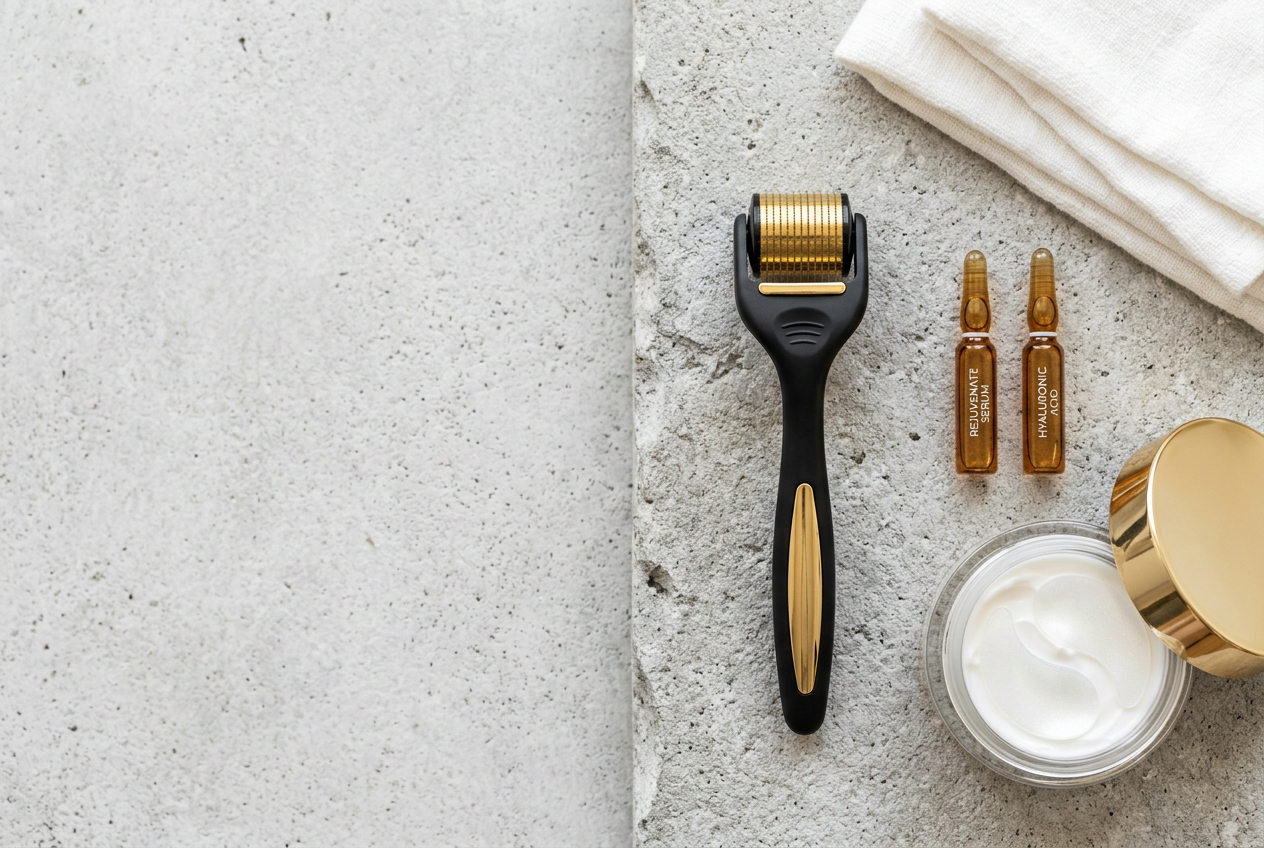

Do – Treat Your Skin Like a Wound for the First 24–48 Hours
Skin that has just been microneedled is best treated as what it essentially is: a wound, however microscopic, that calls for sterile and gentle handling. Even ordinary tap water should be avoided in the first few hours.
Don't – Apply Makeup for 24–48 Hours
Makeup should wait the full forty-eight hours, since cosmetic products can carry bacteria directly into open micro-channels. The redness that appears in this window is not something to be concealed but simply endured.
Do – Use a Hyaluronic Acid Serum to Support Healing
Hyaluronic acid earns its reputation as something of a hero ingredient in this context. It draws water into the skin and supports repair without introducing anything that might irritate.
Don't – Use Active Ingredients (Retinol, Acids, Vitamin C)
These ingredients do the opposite of what healing skin needs, and are best set aside until the skin has had five to seven days to recover. Reintroducing them too soon risks undoing the calm the skin has only just found.
Do – Cleanse with a Gentle, Soap-Free Cleanser
Cleansing should be gentle and soap-free, with the skin patted dry rather than rubbed. This protects the healing micro-channels beneath the surface from being disturbed.
Don't – Exercise, Sweat or Swim for 48–72 Hours
Sweat and pool or sea water carry a genuine risk of bacterial contamination in this state. These are worth avoiding for forty-eight to seventy-two hours, after which normal activity can resume.
Do – Stay Out of the Sun and Use SPF Diligently
Sun protection becomes non-negotiable for at least two weeks, given how vulnerable healing skin is to hyperpigmentation. Diligence here does more to protect the final result than almost any other single habit.
Don't – Expect Immediate Results
Results are a matter of collagen rather than instant transformation, typically taking four to six weeks to become visible. Most people need several sessions spaced four to six weeks apart before the full effect is realised; this is not a treatment that rewards impatience.
Skincare Ingredients to Embrace vs. Avoid Post-Procedure
Certain ingredients belong on healing skin and certain ones do not, and the distinction is not difficult to remember once the underlying logic is clear:
- Hyaluronic acid hydrates without provoking.
- Ceramides help rebuild the barrier that treatment has thinned.
- Panthenol soothes.
- Aloe vera calms inflammation.
- Squalane offers hydration without weight.
- Centella asiatica, often labelled simply as cica, is prized for its calming, restorative qualities.
What should be avoided is anything that asks the skin to do more work than it is currently capable of: retinoids in their various forms, alpha-hydroxy acids such as glycolic, lactic, and mandelic, beta-hydroxy acids like salicylic acid, vitamin C in its most acidic form, exfoliating enzymes such as papain and bromelain, benzoyl peroxide, and fragrance or essential oils, which carry their own risk of allergic reaction.
None of these are permanently forbidden; they are simply premature. Reintroducing them is a matter of patience rather than avoidance—waiting for the practitioner's guidance, patch testing, starting at once a week, and paying close attention to how the skin responds before increasing frequency.
How to Build a Post-Procedure Skincare Routine – A Step-by-Step Guide
Immediate Aftercare (Days 1–3)
- Cleanser: gentle, non-foaming, used only with lukewarm water
- Treatment: whatever soothing serum or balm has been recommended
- Moisturiser: rich enough to support the barrier, light enough not to clog it
- Sunscreen: mineral SPF 50 whenever the skin will see daylight
- Avoid: actives, makeup, and heavy occlusive products
Early Recovery (Days 4–7)
- Continue gentle cleansing
- Introduce hyaluronic acid, if it hasn't been already
- Moisturise as often as the skin requires
- Keep sun protection constant
- Avoid actives and exfoliants a little longer
Returning to Normal (Days 7–14)
- Reintroduce one active ingredient at a time
- Watch closely for any sign of irritation
- Continue wearing sunscreen without exception
- Allow the full routine to return gradually, as the skin allows
Long-Term Maintenance (Beyond 14 Days)
- Maintain ongoing sun protection to safeguard whatever has been gained
- Return to regular exfoliation once the skin has genuinely healed
- Keep the routine that preserves the skin's natural glow and barrier strength
Potential Side Effects to Watch For
A certain degree of reaction is simply the ordinary cost of these treatments, and should not be mistaken for something having gone wrong.
- Botox may bring mild bruising, a passing headache, or a few days of asymmetry.
- Peels bring redness, flaking, and mild stinging.
- Microneedling brings redness, pinpoint bleeding, and mild swelling.
What falls outside this range—severe or worsening pain, pus or discharge, fever, blistering, or redness that refuses to fade on schedule—deserves a prompt call to the practitioner rather than a wait-and-see approach.
Frequently Asked Questions About Post-Procedure Skincare
- When can the regular skincare routine resume? This depends on the treatment, though most people are back to their full routine within roughly two weeks.
- Is makeup permitted after Botox, peels, or microneedling? Generally after twenty-four hours for Botox, three to five days for a peel, and twenty-four to forty-eight hours for microneedling.
- How soon can exercise resume? Around twenty-four to forty-eight hours after Botox, five to seven days after a peel, and forty-eight to seventy-two hours after microneedling.
- Is it safe to wash the face after treatment? Yes, provided it is done gently, with lukewarm water and whatever cleanser has been recommended.
- When do results become visible? Botox typically settles within three to seven days, peel results unfold over one to two weeks, and microneedling results build gradually across four to six weeks.
- Why does sun protection matter so much? Healing skin is markedly more vulnerable to ultraviolet damage, which raises the risk of hyperpigmentation and can compromise results that took real effort to achieve.
- Can these treatments be combined? Sometimes, though timing and sequencing matter a great deal, and this is a question best answered by the practitioner rather than guesswork.
Conclusion
Whether you've had Botox, a chemical peel, or microneedling, the underlying principles of good aftercare are remarkably similar: keep things gentle, keep your skin hydrated, protect it religiously from the sun, and resist the urge to rush the process. Every treatment comes with its own specific dos and don'ts, but patience and consistency are the common threads that tie them all together.
Your practitioner's personalised advice should always take priority over anything you read online, including this article, so keep that follow-up appointment and ask questions if anything feels uncertain. You've already invested in your skin. Give the aftercare the same level of care, and it will show.