


When SkinCeuticals launches a new serum, the skincare world pays attention. Known for their science-backed, dermatologist-approved formulations, the brand has built a reputation on results rather than hype. Their latest release, P-TIOX, is no exception—and it's already generating serious buzz.
But what exactly is it? A peptide serum that claims to reduce the appearance of nine types of wrinkles. Inspired by the effects of anti-wrinkle injections but formulated as a topical, non-invasive treatment, P-TIOX positions itself in an interesting space: it's not a replacement for injectables, but a complementary product designed to target expression lines that even neurotoxins can struggle with. So, does it deliver on its promises? Let's dive into the science, the ingredients, and the real-world results.
P-TIOX Review: What This Peptide Serum Actually Is
P-TIOX is an advanced peptide anti-wrinkle serum formulated to reduce the appearance of contraction lines—the wrinkles caused by repeated facial movements like frowning, squinting, and smiling. Unlike antioxidant serums that primarily protect against environmental damage, P-TIOX is designed to modulate the look of dynamic wrinkles, improving skin texture and radiance in the process.
The serum's name is no accident: it nods to its positioning in the neuromodulator conversation without overpromising. It's a topical product, not an injectable, and it works through a completely different mechanism. While injectables temporarily relax facial muscles, P-TIOX uses a blend of peptides and synergistic actives to improve the appearance of contraction lines at the skin level.
Inside the Bottle: The Key Ingredients Powering P-TIOX
A product is only as good as its formulation. P-TIOX combines an advanced peptide complex with a carefully selected supporting cast of ingredients:
- Advanced Peptide Complex (Hexapeptide + Dipeptide) — These peptides are designed to help soften the appearance of expression lines by working on the skin's surface where repeated muscle movement leaves its mark. Peptides won't stop a muscle from contracting, but they're formulated to support skin's resilience in these high-movement zones. It's worth noting that these are well-studied peptides—not obscure or untested compounds. The dipeptide has been studied for its ability to mildly attenuate the skin-level signalling associated with fine lines. It's a subtle but targeted approach to expression lines.
- 5% PHA (Gluconolactone) — A gentle exfoliant from the polyhydroxy acid family. PHAs work on the skin's surface without the sting that glycolic or lactic acid can bring, making them suitable even for reactive or sensitive skin. Here, it's doing double duty: refining texture and encouraging a smoother, more even surface.
- 5% Niacinamide — Vitamin B3 is one of the most well-evidenced multitaskers in skincare. It supports the skin barrier, helps calm the look of blotchiness and discolouration, and generally makes skin look more even and settled. At 5%, it's a meaningful concentration.
- 1% Laminaria Digitata Extract — A brown seaweed extract included for its hydrating and soothing properties, helping balance out the exfoliating and active ingredients elsewhere in the formula.
What P-TIOX Promises to Deliver (And the Data Behind It)
SkinCeuticals backs P-TIOX with a 12-week clinical study, and the results are focused on nine specific types of contraction lines: nasolabial folds, forehead wrinkles, glabellar wrinkles, crow's feet, cheek fold wrinkles, marionette lines, under-eye wrinkles, inter-ocular wrinkles and global fine lines. Subjects also saw improvements in skin texture, pore appearance and radiance.
Worth noting: this is a topical serum, and results build gradually with consistent use — this isn't an instant-fix product, and it isn't designed to be one. The value here is cumulative, not a same-day transformation.
Who Should Be Using P-TIOX?
This is one of the more inclusive serums in the SkinCeuticals range. It’s formulated for dry, normal, oily, combination and sensitive skin types, and is aimed at anyone dealing with visible ageing, fine lines and wrinkles — particularly expression lines around the forehead, eyes and mouth.
It’s a strong option if:
- You’re starting to notice movement-related lines (forehead creasing, “elevens,” crow’s feet) and want a preventative or supportive step before or alongside more invasive treatments.
- You want a serum that multitasks — tackling texture and radiance rather than targeting just one concern.
- You’ve had anti-wrinkle injections in areas like the forehead or glabella but still have visible movement or lines in harder-to-treat zones, such as around the mouth.
- Your skin is sensitive to stronger actives and you want a gentler entry point into peptides and PHA exfoliation.
How to Use P-TIOX for Best Results
Using P-TIOX in Your Morning Skincare Routine
- Always start your morning routine by thoroughly cleansing your face to remove any overnight impurities and prepare the skin for optimal absorption.
- If you choose to incorporate an antioxidant serum into your regimen, it is best applied immediately after cleansing and before P-TIOX, as this layered approach helps neutralise free radicals while enhancing the serum’s overall performance.
- You must then dispense five to six drops of P-TIOX into the palm of your hand and gently dab the product onto your forehead, cheeks, and chin before blending it evenly into your skin to ensure full coverage.
- After allowing P-TIOX to absorb, you should follow up with a moisturiser to lock in hydration and support the skin’s natural barrier function throughout the day.
- The final and non-negotiable step in your morning routine is applying a broad-spectrum sunscreen, which is especially critical because P-TIOX contains PHA that can increase sun sensitivity.
Using P-TIOX in Your Morning Skincare Routine
- Begin by cleansing your skin thoroughly to eliminate makeup, pollution, and excess oil, creating a clean canvas for the night-time treatment.
- After cleansing, apply P-TIOX and blend it into the skin as the primary active treatment for your night-time repair process.
- Following the P-TIOX application, you should apply a moisturiser to replenish hydration, and if you use retinol, you need to sequence it correctly—typically by applying retinol after P-TIOX or alternating nights, depending on your skin’s tolerance.
Since the clinical studies that support P-TIOX’s effectiveness were based on twice-daily use over a full 12-week period, you must commit to this consistent schedule rather than using the product sporadically.
Can You Combine P-TIOX with Vitamin C or Retinol?
Yes, and this is actually where P-TIOX shows its versatility as a layering serum rather than a standalone hero product:
- Combining P-TIOX With Vitamin C: SkinCeuticals' own guidance for layering antioxidant serums alongside other treatment serums is to apply the antioxidant first, after cleansing, followed by your treatment serum, then moisturiser and SPF. This means you're not choosing between an antioxidant serum and a peptide serum — they're designed to work in sequence, not in competition.
- Combining P-TIOX With Retinol: Retinol is best kept to the evening, and the general sequencing principle in skincare is to let your treatment actives sit on clean skin first, giving them the most direct contact, then follow with additional layers. Because P-TIOX contains PHA — a gentle exfoliant — pairing it with retinol on the same night can increase the chance of sensitivity, particularly if your skin is new to either ingredient. If you're introducing both, it's sensible to alternate nights initially (P-TIOX one evening, retinol the next) and build up frequency slowly, watching how your skin responds. Once your skin has adjusted, many people can use both in the same routine, just not necessarily piled on in the same five minutes.
As always with actives, patch test and introduce new products one at a time so you can actually tell what's working — and what isn't agreeing with your skin.
P-TIOX vs C E Ferulic: What's the Difference?
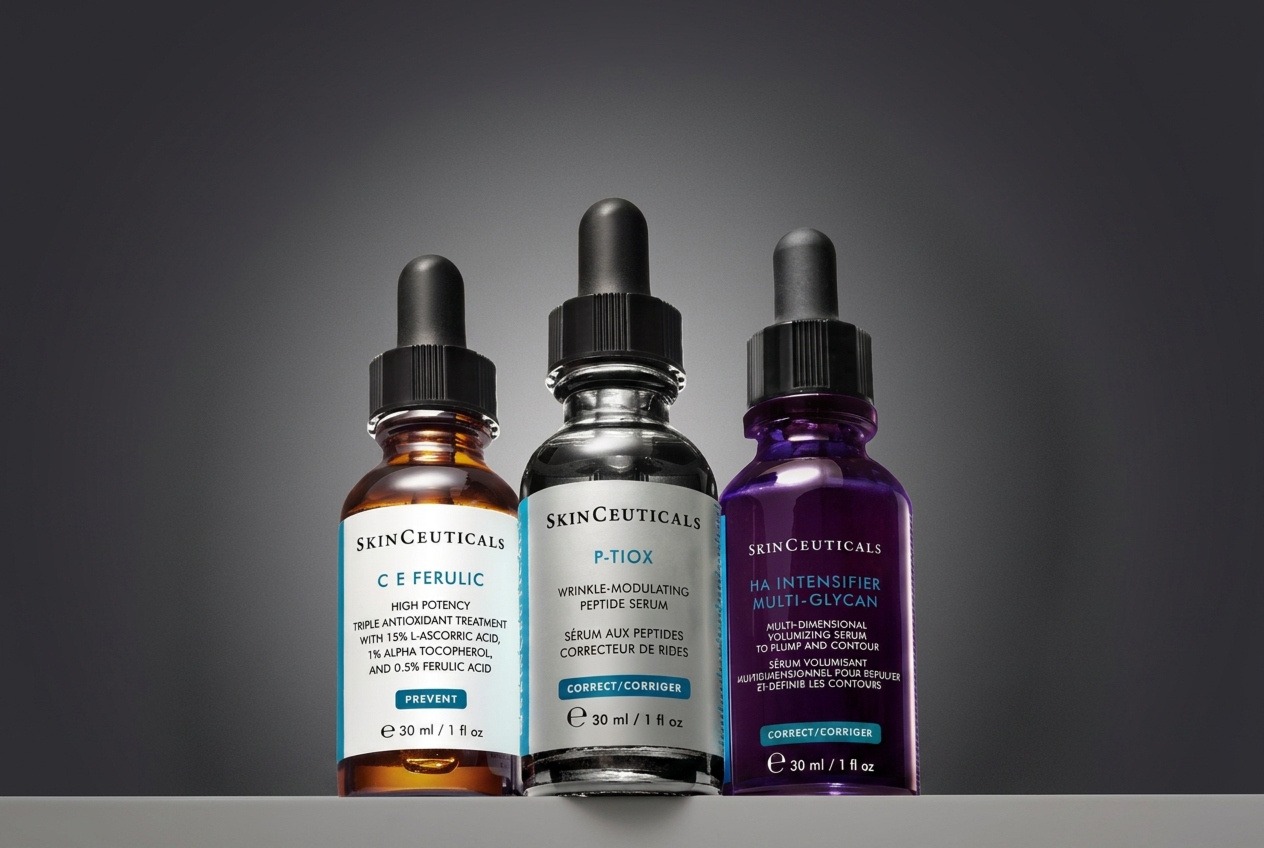

These two serums solve different problems, and understanding that distinction is the key to deciding whether you need one, the other, or both.
C E Ferulic is an antioxidant serum built around 15% L-ascorbic acid, vitamin E and ferulic acid. Its job is environmental defence — neutralising free radical damage from UV exposure, pollution and general daily wear, while also brightening tone and softening the look of photodamage over time. It's a protection-first product, worn in the morning under sunscreen.
P-TIOX, by contrast, is not primarily an antioxidant. It's peptide-led, formulated to target expression lines caused by repeated facial movement, while also refining texture via PHA and calming tone via niacinamide. It's a correction-and-support serum, not a shield.
In short: C E Ferulic defends, P-TIOX targets. They're not competing for the same job, which is exactly why SkinCeuticals recommends layering them rather than picking one over the other, if your budget and routine allow for it.
Intensifier: Hydration or Expression Lines?
H.A. Intensifier is a hydration-focused serum built around concentrated hyaluronic acid, proxylane, and licorice root and purple rice extracts. Its core job is to support the skin's own hyaluronic acid levels and deliver surface hydration, which plumps the look of fine lines and improves firmness and smoothness. It's often positioned as a complement to injectables and fillers, helping maintain a hydrated, bouncy look between treatments.
P-TIOX overlaps here in that both products address the appearance of fine lines, but the mechanism is different. H.A. Intensifier works through hydration and plumping; P-TIOX works through peptides that target the surface effects of muscle movement, alongside exfoliation and brightening. If your main concern is dehydration and loss of bounce, H.A. Intensifier is the more direct answer. If your main concern is expression lines and overall texture, P-TIOX takes the lead.
Some people use both — H.A. Intensifier for hydration and plumping, P-TIOX for the expression-line and texture work — but if you're building a routine from scratch, it's worth choosing based on which concern is more pressing for your skin right now.
P-TIOX vs Botox: Can a Serum Really Compete?
It's a fair question, given how P-TIOX is marketed around "hard-to-inject" areas and used in conjunction with anti-wrinkle treatments. But it's important to be clear: P-TIOX is a topical cosmetic serum, not an injectable, and it does not work the same way anti-wrinkle injections do.
Anti-wrinkle injections work by temporarily relaxing the underlying muscle responsible for repeated contraction, which is what causes expression lines to form in the first place. P-TIOX doesn't touch muscle activity at all — it works on the skin's surface, using peptides and supporting actives to help improve the appearance of the lines that muscle movement has left behind.
Where the two genuinely intersect is in areas that are difficult or undesirable to inject, such as around the mouth, or as a complementary step for people already having injectable treatments who want to support skin quality in between appointments. SkinCeuticals is explicit that P-TIOX should never be injected and is for topical use only on healed skin, and that anyone considering an aesthetic treatment should speak to a medical professional first.
So: not a replacement, but a legitimate topical companion if you're already exploring injectables, or a starting point if you're not ready for (or interested in) needles at all.
Is P-TIOX Worth It? Breaking Down the Cost
At 30ml with twice-daily use guidance, expect this bottle to last somewhere around two to three months with consistent use, depending on how generously you apply it. That puts it firmly in prestige skincare territory pricing-wise, in line with the rest of the SkinCeuticals correct and treat range.
Whether that's "worth it" comes down to what you're comparing it against. If you're weighing it up against a basic drugstore peptide serum, you're paying for concentration, formulation stability, and clinical backing on a specific, well-defined set of concerns. If you're weighing it against professional treatments like anti-wrinkle injections, it's a different category entirely — cheaper per use, but working on a different mechanism with more gradual, surface-level results.
For those specifically dealing with expression lines who want a research-backed topical option, rather than a jack-of-all-trades anti-ageing serum, P-TIOX earns its price tag. For those with primarily hydration or environmental damage concerns, your money is better spent on H.A. Intensifier or C E Ferulic first, and P-TIOX added in later as your routine develops.
P-TIOX Review: Quick Answers to Common Questions
- How long until I see results? The clinical study behind P-TIOX ran for 12 weeks, so that's a realistic timeframe to expect visible change with consistent, twice-daily use. Some people notice improvements in texture and radiance sooner, but the contraction-line results are built on the full 12-week window.
- Can I use P-TIOX around my eyes? The application guidance is to dab the product onto the forehead, cheeks and chin, blending it in — it's not specifically designed as an eye cream, so if you want to target the eye area, patch test carefully first and avoid getting product too close to the lash line.
- Is P-TIOX suitable for sensitive skin? Yes, it's formulated to suit sensitive skin alongside dry, normal, oily and combination types. That said, any product containing PHA carries some exfoliating action, so if your skin is reactive, introduce it gradually — every other day to start — before working up to twice daily.
- Do I need to use P-TIOX forever to keep results? As with most cosmetic actives, visible improvements are generally tied to continued use. Stopping won't cause lines to worsen beyond their natural baseline, but the texture and radiance benefits are maintained through consistency, not a one-off course.
Final Verdict: Is P-TIOX Worth Adding to Your Routine?
P-TIOX isn't trying to replace your dermatologist, your injectables, or your existing antioxidant serum — and it's better for it. It's a focused, well-formulated peptide serum for expression lines, doing a specific job well rather than promising to do everything. If contraction lines, texture and radiance are what you're after, it's a genuinely worthwhile addition to a considered routine — just don't expect it to do a Botox needle's job.